Percent Concentration By: Cristel ImbagThe use of percentages is a common way of expressing the concentration of a solution. It is a straightforward approach that you have used earlier when dealing with the composition of compounds. There are, however, some differences. One is that the concentrations of solution are variable while the composition of compounds is constant. Another is that the percentages can be calculated using volumes as well as weights, or even both together. One way of expressing concentrations, with which you might be familiar, is by volume percent. Another is by weight percent. Still another is a hybrid called weight/volume percent. In the pages of this section we will look at how to calculate each and the cases where each is generally used.
Mass Percentage One way
of representing the concentration of an element in a compound or a
component in a mixture. Mass percentage is calculated as the mass of a
component divided by the total mass of the mixture, multiplied by 100%. Volume Percentage Volume percent is a common expression of a solution's concentration. It is defined as: It is related to volume fraction by dividing by 100%. Volume percent is usually used when the solution is made by mixing twofluids, such as liquids or gases. However, percentages are only additive forideal gases. The solute is what you get from the solution. For example, if you distilled salt water, the solution would be the salt water, and the solvent would be thedistilled water. A solution consists of a solvent, which is commonly a liquid, and a solute, which may be any substance that dissolves in the solvent. For example, if salt water (a solution) is distilled, water (the solvent) passes over into the receiver and salt (the solute) remains in the still. In the case of a mixture of ethanol and water, which are miscible in all proportions, the designation of solvent and solute is arbitrary. The volume of such a mixture is slightly less than the sum of the volumes of the components. Thus, by the above definition, the term "40% alcohol by volume" refers to a mixture of 40 volume units of ethanol with enough water to make a final volume of 100 units, rather than a mixture of 40 units of ethanol with 60 units of water. Example: You have 40.0ml of C6H5CH3 that is put into 75.0ml of C6H6, what is the percent volume of C6H5CH3? Solution: (40.0ml) / (115.0ml) x 100 = 34.8% of C6H5CH3
Weight/Volume Percentage * weight/volume percentage concentration is usually abbreviated as w/v (%) * w/v (%) = mass solute ÷ volume solution x 100 * common units are g/100mL (%) * weight/volume is a useful concentration measure when dispensing reagents. Reference:About.com Chemistry Volume-volume percentage, Chembuddy websiteAusetute.com.auWikepedia |
Standardization Method Acid Base TitrationBy: Alleta Fae S. LiwagStandardization is the process of determining the exact concentration (molarity) of a solution. Titration is one type of analytical procedure often used in standardization. In a titration, an exact volume of one substance is reacted with a known amount of another substance. The point at which the reaction is complete in a titration is referred to as the endpoint. A chemical substance known as an indicator is used to indicate (signal) the endpoint. How to Standardize? 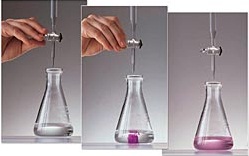 Example 1
A 0.128 g sample of KHP (HKC8H4O4) required 28.54 mL of NaOH solution to reach a phenolphthalein endpoint. Calculate the molarity of the NaOH. HKC8H4O4 + NaOH -----> NaKC8H4O4 + H2O (0.128 g KHP)(1 mol / 204.23 g KHP ) = 6.267 x 10⁻⁴ mol KHP (6.267 x 10⁻⁴ mol KHP)(1 mol NaOH / 1 mol KHP) = 6.267 x 10⁻⁴ mol NaOH 6.267 x 10⁻⁴ mol NaOH / 0.02854 L NaOH = 0.0220 M NaOH
HCl + NaOH -----> NaCl + H2O (0.02372 L NaOH)(0.0220 mol NaOH / 1 L NaOH) = 5.218 x 10⁻⁴ mol NaOH (5.218 x 10⁻⁴ mol NaOH)(1 mol HCl / 1 mol NaOH) = 5.218 x 10⁻⁴ mol HCl 5.218 x 10⁻⁴ mol HCl / 0.02000 L HCl = 0.0261 M HCl REFERENCE: http://www.chem.latech.edu/~deddy/chem104/104Standard.htm |
Direct Tirtation
By: Zhenna Marriz AypaTitration is a standard laboratory method of quantitative/chemical analysis which can be used to determine the concentration of a known reactant. Using a calibrated burette to add the titrant, it is possible to determine the exact amount that has been consumed when the endpoint is reached. The endpoint is the point at which the titration is stopped. Direct titration is a way to determine the contents of a substance quantitatively. Scientists may be aware of a reactant, but not know the reactant's quantity. Direct titration is sometimes based on indicators that respond to the analyzed material, called the analyte.Scientists rely on direct titration to find the quantity of a substance within a solution with chemical reactions.  SAMPLE PROBLEM 1 A titration of a 25.00 mL sample of a hydrochloric acid solution of unknown molarity reaches the equivalence point when 38.28 mL of 0.4370 M NaOH solution has been added. What is the molarity of the HCl solution?
SOLUTION 1. ANALYZE • What is given in the given problem? - the volume of the HCl solution titrated, and the molarity and volume of NaOH solution used in the titration. • What are you asked to find? - the molarity of the HCl solution
3. Compute
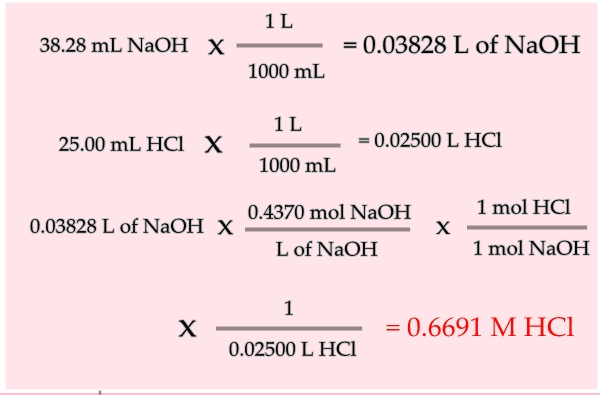 - http://go.hrw.com/resources/go_sc/mc/HUGPS209.PDF |

Tirtation an Acid-Base Neutralization
By: Mark Anthony BasilioAcids and Bases - Neutralizing a Base with an Acid Ca(OH)2 is a strong base and will dissociate completely in water to Ca2+ and OH-. For every mole of Ca(OH)2 there will be two moles of OH-. The concentration of Ca(OH)2 is 0.01 M so [OH-] will be 0.02 M.To the solution will be neutralized when the number of moles of H+ equals the number of moles of OH-. Step 1: Calculate the number of moles of OH-. Molarity = moles/volume moles = Molarity x Volume moles OH- =
0.02 M/100 ml
Step 2: Calculate the Volume of HCl needed Molarity = moles/volume Volume = moles/Molarity A titration is a volumetric technique in which a solution of one reactant (the titrant) is added to a solution of a second reactant (the "analyte") until the equivalence point is reached. The equivalence point is the point at which titrant has been added in exactly the right quantity to react stoichiometrically with the analyte. If either the titrant or analyte is colored, the equivalence point is evident from the disappearance of color as the reactants are consumed. Otherwise, an indicator may be added which has an "endpoint" (changes color) at the equivalence point, or the equivalence point may be determined from a titration curve. The amount of added titrant is determined from itsconcentration and volume: n(mol) = C(mol/L) x V(L) and the amount of titrant can be used in the usual stoichiometric calculation to determine the amount of analyte. The object of a titration is always to add just the amount of titrant needed to consumeexactly the amount of substance being titrated. In the NaOH—CH3COOH reaction [Eq. (1)], the equivalence point occurs when an equal molar amount of NaOH has been added from the graduated cylinder for every mole of CH3COOH originally in the titration flask. That is, at the equivalence point the ratio of the amount of NaOH, added to the amount of CH3COOH consumed must equal the stoichiometric ratio 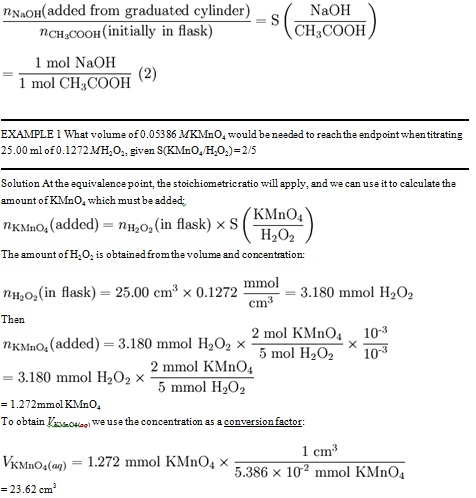 Note that overtitrating [adding more than 23.62 cm3 of KMnO4(aq) would involve an excess (more than 1.272 mmol) of KMnO4. Source: http://chemed.chem.wisc.edu/chempaths/GenChem-Textbook/Titrations-875.html http://chemistry.about.com/od/workedchemistryproblems/a/neutralizeacid.htm |
Indirect TirtationBy: Rosiel MarianoBack titration (Indirect titration) is a titration done in reverse;; instead of titrating the original sample, a known excess of standard reagent is added to the solution, and the excess is titrated. A back titration is useful if the endpoint of the reverse titration is easier to identify than the endpoint of the normal titration, as with precipitation reactions. Back titrations are also useful if the reaction between the analyte and the titrant is very slow, or when the analyte is in a non-soluble solid. PROPERTIES OF A BACK TITRATION •React
with the excess volume of reactant which has been left over after completing
reaction with the analyte from the normal titration •The
substance or solution of unknown concentration of excess intermediate reactant
is made to react with known volume and concentration of intermediate reactant
solution in back titration•Throughout
back titration, the reaction can reach the completion quickly as the excess
reactant that react with the NaOH (as example) heated, and is much easier
to measure •Back
titration also an indirect titration procedure •the
proportion consumed in the reaction of back titration being obtained by
difference PURPOSE OF BACK TITRATION Back titration is designed to resolve
some of the problems encountered with forward or direct titration. Possible
reasons for devising back titration technique are: •1: The analyte may be in solid form
•2: The analyte may contain
impurities which may interfere with direct titration. Consider the case of
contaminated chalk. We can filter out the impurities before the excess reactant
is titrated and thus avoid this situation. •3: The analyte reacts slowly with
titrant in direct or forward titration. The reaction with the intermediate
reactant can be speeded up and reaction can be completed say by heating. •4: Weak acid –
weak base reactions can be subjected to back titration for analysis of solution
of unknown concentration. Recall that weak acid-weak weak titration does not
yield a well defined change in pH, which can be detected using an indicator. ADVANTAGES OF BACK TITRATION •useful when trying to
work out the amount of an acid or base in a non-soluble solid. •useful if the endpoint
of the reverse titration is easier to identify than the endpoint of the normal
titration DISADVANTAGES OF BACK TITRATION •Needs
skill and practise for effective results •Instruments
have to be properly calibrated since it will give affected the final result. •Reactivity
of the elements to be titrated should be well researched since this may affect
the end point. •Time
consuming if done manually CALCULATIONS Example 1 150.0 mL of 0.2105 M nitric acid was added in excess to 1.3415 g calcium carbonate. The excess acid was back titrated with 0.1055 M sodium hydroxide. It required 75.5 mL of the base to reach the end point.Calculate the percentage (w/w) of calcium carbonate in the sample. 1.EXTRACT INFORMATION •HNO3 V=150.0 mL M=0.2105 M •CACO3
Mass= 1.3415 g •NAOH
M=0.1055 M V=75.5 mL 2. Write balanced equation 2HNO3 + CaCO3 ® Ca(NO3)2 + CO2 + H2O ------ 1
HNO3 + NaOH ® NaNO3 + H2O ------- 2 2 mole of HNO3 react with 1 mole of CaCO3 1 mole of HNO3 react with 1 mole of NaOH 3. Calculate no of mole Initial amount HNO3: No of mole of acid = 0.2105 x 150 = 31.575 mole acid. Excess acid No of mole of excess acid = 0.1055 x 75.5 = 7.965 mmole acid mole of acid reacted with CaCO3 = ( 31.575 – 7.965 ) = 23.61 mole acid 4. Mole ratio 2 mole of HNO3 react with 1 mole of CaCO3 Thus,23.61 mole of HNO3 react with ½(23.61) mole of CaCO3 mole of CaCO3 = ½ x mole acid = ½ x 23.61 = 11.805 mole CaCO3. 5. Find mass
Gram CaCO3 = mole x molar mass = 11.805 x 10-3 x 100 = 1.1805 g. 6.Find percentage % CaCO3 = Ï 100
= Ï 100 = 87.99 % (w/w) REFERENCES http://en.wikipedia.org/wiki/Titration#Back_titration |
Red-ox ReactionBy: Reagan Delos Reyes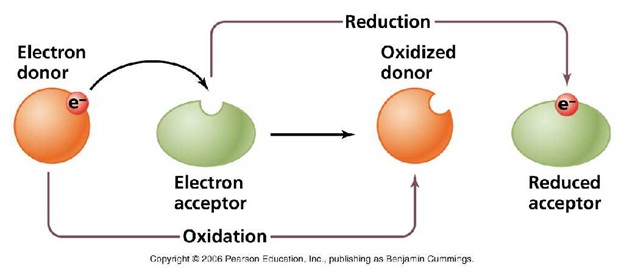 Redox reactions(oxidation-reduction reactions)- have a number of similarities to acid-base reactions. Fundamentally, redox reactions are a family of reactions that are concerned with the transfer of electrons between species. Like acid-base reactions, redox reactions are a matched set -- you don't have an oxidation reaction without a reduction reaction happening at the same time. Oxidation refers to the loss of electrons, while reduction refers to the gain of electrons. Each reaction by itself is called a "half-reaction", simply because we need two (2) half-reactions to form a whole reaction. In notating redox reactions, chemists typically write out the electrons explicitly: Cu (s) ----> Cu2+ + 2 e- This half-reaction says that we have solid copper (with no charge) being oxidized (losing electrons) to form a copper ion with a plus 2 charge. Notice that, like the stoichiometrynotation, we have a "balance" between both sides of the reaction. We have one (1) copper atom on both sides, and the charges balance as well. The symbol "e-" represents a free electron with a negative charge that can now go out and reduce some other species, such as in the half-reaction: 2 Ag+ (aq) + 2 e- ------> 2 Ag (s) Here, two silver ions (silver with a positive charge) are being reduced through the addition of two (2) electrons to form solid silver. The abbreviations "aq" and "s" mean aqueous and solid, respectively. We can now combine the two (2) half-reactions to form a redox equation: 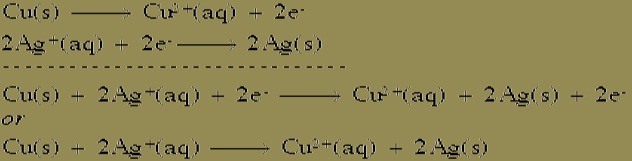 As a summary, here are the steps to follow to balance a redox equation in acidic medium (add the starred step in a basic medium): 1. Divide the equation into an oxidation half-reaction and a reduction half-reaction 2. Balance these o Balance the elements other than H and O o Balance the O by adding H2O o Balance the H by adding H+ o Balance the charge by adding e- 3. Multiply each half-reaction by an integer such that the number of e- lost in one equals the number gained in the other 4. Combine the half-reactions and cancel 5. **Add OH- to each side until all H+ is gone and then cancel again** |
Back Tirtation By: Kathleen Caralde
What is indirect titration? This method employs a preliminary reaction in which the analyte is replaced by an equivalent amount of another substance which is then determined by titration. The titrant and analyte do not react with each other, but are related through the other substance. e.g. Determination of iron Fe+3+2I-2Fe+2+12 (analyte) I2+2S2O3-2I+S4O6-2 (titrant) It is generally a two-stage analytical technique: a. Reactant A of unknown concentration is reacted with excess reactant B of known concentration. b. A titration is then performed to determine the amount of reactant B in excess. Or scientifically speaking.. Preliminary reaction: aA + rR à pP Titration reaction: pP + tT à fF Imdirect titrations are used when: * one of the reactants is volatile, for example ammonia. * an acid or a base is an insoluble salt, for example calcium carbonate * a particular reaction
is too slow * direct titration would involve a weak acid - weak base titration
(the end-point of this type of direct titration is very difficult to observe)
Example : Indirect Titration to Determine the Concentration of a Volatile Substance A student was asked to determine the concentration of ammonia, a volatile substance, in a commercially available cloudy ammonia solution used for cleaning. First the student pipetted 25.00mL of thecloudy ammonia solution into a 250.0mL conical flask. 50.00mL of 0.100M HCl(aq) was immediately added to the conical flask which reacted with the ammonia in solution. The excess (unreacted) HCl was then titrated with 0.050M Na2CO3(aq). 21.50mL of Na2CO3(aq) was required. Calculate the concentration of the ammonia in the cloudy ammonia solution. Step 1: Determine the amount of HCl in excess from the titration results a. Write the equation for the titration: 2HCl(aq) + Na2CO3(aq) → 2NaCl(aq) + CO2(g) + H2O(l) acid + carbonate → salt + carbon dioxide + water b. Calculate the moles, n, of Na2CO3(aq) that reacted in the titration: n = M x V c. M = 0.050 molL-1 d. V = 21.50mL = 21.50 x 10⁻³L n(Na2CO3(aq)) = 0.050 mol/L x 21.50 x 10⁻³ L = 1.075 x 10⁻³ mol e. Use the balanced chemical reaction for the titration to determine the moles of HCl that reacted in the titration. From the balanced chemical equation, 1 mole Na2CO3 react with 2 moles of HCl So, 1.075 x 10⁻³ mol Na2CO3 reacted with 2 x 1.075 x 10-3 moles HCl n(HCltitrated) = 1.075 x 10⁻³ mol HCL x 2 mol Na2CO3 1mol HCl = 2.150 x 10⁻³ mol f. The amount of HCl
that was added to the cloudy ammonia solution in excess was 2.150 x 10⁻³ mol Step 2: Determine the amount of ammonia in the cloudy ammonia solution a. Calculate the total moles of HCl originally added to the diluted cloudy ammonia solution: n(HCltotal added) = M x V M = 0.100 molL V = 50.00mL = 50.00 x 10⁻³L n(HCltotal added) = 0.100 molL x 50.00 x 10⁻³ L = 5.00 x 10⁻³ mol b. Calculate the moles of HCl that reacted with the ammonia in the diluted cloudy ammonia solution n(HCltitrated) + n(HClreacted with ammonia) = n(HCltotal added) n(HCltotal added) = 5.00 x 10⁻³ mol n(HCltitrated) = 2.150 x 10⁻³ mol 2.150 x 10⁻³ + n(HClreacted with ammonia) = 5.00 x 10⁻³ n(HClreacted with ammonia) = 5.00 x 10⁻³ - 2.150 x 10-3 = 2.85 x 10⁻³ mol c. Write the balanced chemical equation for the reaction between ammonia in the cloudy ammonia solution and the HCl(aq). NH3(aq) + HCl(aq) → NH4Cl(aq) d. From the balanced chemical equation, calculate the moles of NH3 that reacted with HCl. From the equation, 1 mol HCl reacts with 1 mol NH3 So, 2.85 x 10⁻³ mol HCl had reacted with 2.85 x 10⁻³ mol NH3 in the cloudy ammonia solution. e. Calculate the ammonia concentration in the cloudy ammonia solution. M = n ÷ V n = 2.85 x 10⁻³ mol (moles of NH3 that reacted with HCl) V = 25.00mL = 25.00 x 10⁻³L (volume of ammonia solution that reacted with HCl) M = 2.85 x 10⁻³ ÷ 25.00 x 10-3 = 0.114 M f. The concentration of ammonia in the cloudy ammonia solution was 0.114M. |
Half Reaction(Review)
By: Cristel Diane Dela Cruz
Half-reaction is the part of an overall reaction that represents, separately, either an oxidation or a reduction. - a half reaction is obtained by considering the change in oxidation states of individual substances involved in the redox reaction. -a half reaction does not occur by itself, at least two such reactions must be coupled so that the electron released by one reactant is accepted by another in order to complete the reaction. -it is a method for balancing oxidation/reduction reactions that occur in aqueous solution -one of the half reaction will illustrate reduction that means the electrons will show up in the reactant side A + e- -> A- -one of the half reaction will illustrate oxydation that means the electrons will show up in the product side B-> B+ + e- Remember : The number of electrons lost by the oxidized species must be equal to the number of electrons gained by the reduced species. Example : When a nickel strip {Ni (s)} is placed in an aqueous solution of copper(II) sulfate {Cu2+, SO42-}, an immediate reaction occurs. Copper metal begins to deposit on the strip. The only source for metallic copper in this system is the copper(II) ions in solution. What is happening to the copper(II) ions to cause them to change into elemental copper? Let's represent this fascinating observation with a chemical equation: 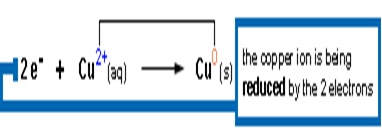 We have just written a half-reaction! In this equation, the copper(II) ion is being reduced When we balance a half-reaction, we first balance the mass of the participating species (atoms, ions, or molecules) and then the charge. In this case, the mass is balanced by adding a copper (atom or ion) to each side. To balance the charge, electrons are added. Notice the addition of 2 electrons to left side of the above equation. These electrons are necessary to reduce a copper(II) ion to metallic copper. If copper(II) ion is being reduced, what is being oxidized? Another way to ask this question is 'where are those electrons coming from?'. Nickel, of course! What is the half-reaction for the oxidation of metallic nickel? Nickel must release 2 electrons to form the nickel(II) ion as shown in the following equation (remember that we balance the mass and then the charge): 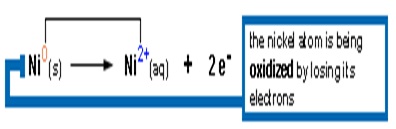
REFERENCES: http://www.youtube.com/watch?v=zKT7QZbto34 |
Molar Mass(Review)
By: Jarlyn LIwag
The molar mass is a physical property. It is defined as the mass of a given substance (chemical element or chemical compound) divided by its amount of substance. Unit = kg/mol or g/mol.
· The molar mass of atoms of an element is given by the atomic weight of the element[2] multiplied by the molar mass constant. Example : M(H) = 1.007 97(7) × 1 g/mol = 1.007 97(7) g/mol
-Some elements are usually encountered as molecules. Example: hydrogen (H2) and sulfur (S8).
· The molar mass of molecules of these elements is the molar mass of the atoms multiplied by the number of atoms in each molecule. Example: M (H2) = 2 × 1.00797 (7) × 1 g/mol = 2.01588 (14) g/mol M (S8) = 8 × 32.065 (5) × 1 g/mol = 256.52 (4) g/mol
· The molar mass of a compound is given by the sum of the standard atomic weights of the atoms which form the compound multiplied by the molar mass constant. Example: M(C12H22O11)= ([12 × 12.0107 (8)] +[22 × 1.007 94 (7)] + [11 × 15.9994(3)]) × 1 g/mol = 342.297 (14) g/mol. |
