Unfollowing the Octet Rule of 8By: Cristel Imbag An atom with less than eight electrons in its valence shell. An atom with less than eight total bonding and nonbonding electrons in a Lewis structure, for example, B in BH3 has an incomplete octet. There are certain atoms of certain elements that can exist in stable compounds forming bonds with less than eight valence electrons. When this occurs, the atom of the element within the molecule is said to contain an incomplete octet. The common examples of such elements are hydrogen (stable with only 2 valence electrons), beryllium (stable with only 4 valence electrons) and boron and aluminum (stable with only 6 valence electrons). For hydrogen 2 valence electrons give it a noble gas structure (like He) so this is much like the octet rule for everything else below period 1. But covalent compounds in groups 2 and 3 can form stable compounds in which the valence electrons are not in the noble gas structure. However, for these compounds you will find that they do form compounds that minimize formal charge.
Example: Good examples of the first type of exception
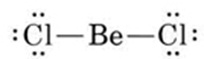
are provided by BeCl2 and BCl3. Beryllium dichloride,
BeCl2, is a covalent rather than an ionic substance. Solid BeCl2
has a relatively Complex structure at room temperature, but when
it is heated to 750°C, a vapor which
consists of separate BeCl2 molecules is obtained. Since Cl atoms do
not readily form multiple bonds, we expect the Be atom to be joined to each Cl
atom by a single bond. The structure is Instead of an octet the valence shell of Be
contains only two electron pairs. Similar arguments can apply to
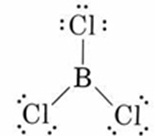
boron trichloride, BCl3, which is a stable gas at room temperature.
We are forced to write its
structure as
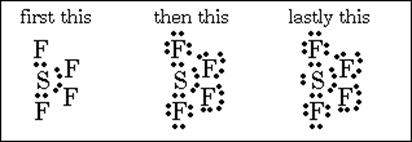
Expanded octet A hypervalent molecule (the phenomenon is sometimes colloquially known as expanded octet) is a molecule that contains one or more main group elements formally bearing more than eight electrons in their valence shells. Phosphorus pentachloride (PCl5), sulfur hexafluoride (SF6), chlorine trifluoride (ClF3), and the triiodide (I3−) ion are examples of hypervalent molecules. Examples : SF4 1. This compound is covalent. 2. Determine the total number of valence electrons available: One sulfur has 6 valence electrons 3. Organize the atoms so there is a central atom (usually the least electronegative) surrounded by ligand (outer) atoms. Hydrogen is never the central atom.
I put the fluorines like I did because I knew I needed an open space for the unbonded pair on the sulfur. If you put the 4 fluorines around the S like in CH4, that's OK. It gets tiresome making all this little graphic files, but hey, I knew that when I took on this project. OK, enough complaining, back to work. 4. Determine a provisional electron distribution by arranging the electron pairs (E.P.) until all available pairs have been distributed:
5. The formal charge (F) on the central atom is zero. The right-hand structure in step 4 is the correct answer. Odd molecule Term invented by Gilbert N. Lewis in 1916 for a molecule containing an odd number of electrons. Taking the p-shell elements, such molecules are rare; they are usually colored and paramagnetic, that is, attracted by a magnet. Odd molecules are 'radicals.' A fine example is nitric oxide, q.v.; nitrogen dioxide is another; chlorine dioxide is also an example, being a reddish-yellow gas. They are all fairly reactive. When including d-shell elements, i.e., the transition metals, the concept mostly doesn't apply, and this 'odd' state is not so unusual. Example: 1. Nitrogen dioxide (NO2) This molecule has a total of 17
electrons to place - five from the nitrogen and 12 from the oxygens. I will go
immediately to the final structure: 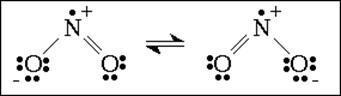 Notice that I show both resonance structures. Since there are three electron domains, this is a trigonal planar arrangement, but it is signified AX2e, to signal the single electron domain, also called a half-filled orbital. The bond angles are not 120°, since the repulsive power of the single electron is less tha if there were two. So, the O-N-O bond angle moves outward to 134.3°. Adding another electron to make NO2¯ (which creates a full non-bonding electron pair, changes the O-N-O angle to 115.4° and removing an electron (to make NO2+) creates an O-N-O bond angle of 180°. |
Geometry MoleculesBy: Alleta Fae S. Liwag
Geometry of Molecules Chart
Steps Used to Find the Shape of the MoleculeTo sum up there are four simple steps to apply the VSEPR theory. 1. Draw the Lewis Structure. 2. Count the number of electron groups and identify them as bond pairs of electron groups or lone pairs of electrons. Remember electron groups include not only bonds, but also lone pairs! 3. Name the electron-group geometry. (State whether it is linear, trigonal-planar, tetrahedral, trigonal-bipyramidal, or octahedral.) 4. Looking at the positions of other atomic nuclei around the central determine the molecular geometry. (See how many lone pairs there are.) (Use the chart as a guide) Reference: http://chemwiki.ucdavis.edu/Wikitexts/UCD_Chem_2A/ChemWiki_Module_Topics/Chemical_Bonding/Geometry_of_Molecules |



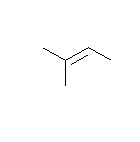






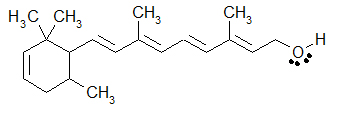


orbital hybridizationBy: cristel diane dela cruz In chemistry hybridization is the concept of mixing atomic orbitals to form new hybrid orbitals suitable for the qualitative description of atomic bonding properties. Hybridised orbitals are very useful in the explanation of the shape of molecular orbitals for molecules. It is an integral part of valence bond theory. The hybrids are named based on the atomic orbitals that are involved in the hybridization, and the geometries of the hybrids are also reflective of those of the atomic-orbital contributors Chemist Linus Pauling first developed the hybridization theory in order to explain the structure of molecules. This concept was developed for such simple chemical systems, but the approach was later applied more widely, and today it is considered an effective heuristic for rationalizing the structures of organic compounds. 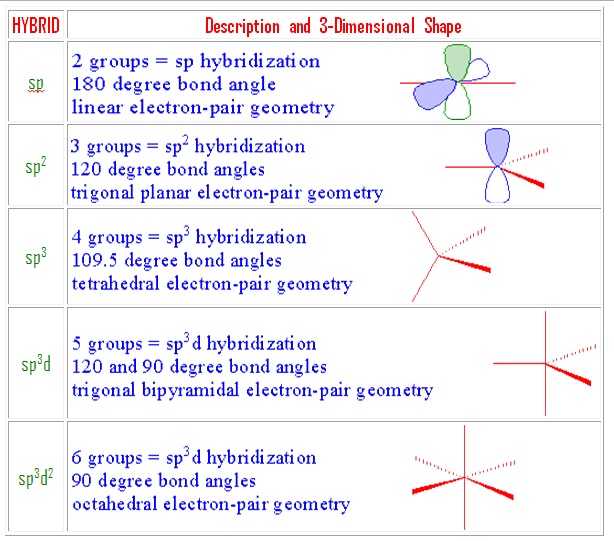 EXAMPLES : Methane, the three 2p orbitals of the carbon atom are combined with its 2s orbital to form four new orbitals called "sp3" hybrid orbitals. The name is simply a tally of all the orbitals that were blended together to form these new hybrid orbitals. Four hybrid orbitals were required since there are four atoms attached to the central carbon atom. These new orbitals will have an energy slightly above the 2s orbital and below the 2p orbitals as shown in the following illustration. Notice that no change occurred with the 1s orbital. 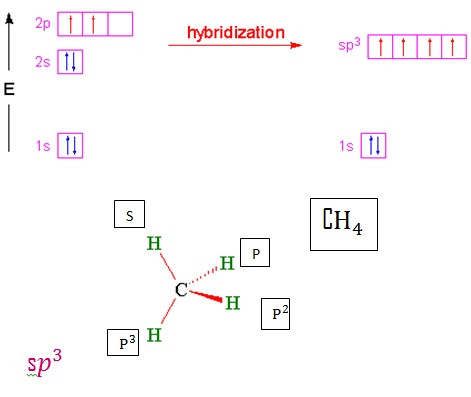 Ammonia, the three 2p orbitals of the nitrogen atom are combined with the 2s orbital to form four sp3 hybrid orbitals. The non-bonded electron pair will occupy a hybrid orbital. Again we need a hybrid orbital for each atom and pair of non-bonding electrons. Ammonia has three hydrogen atoms and one non-bonded pair of electrons when we draw the electron-dot formula. In order to determine the hybridization of an atom, you must first draw the electron-dot formula. 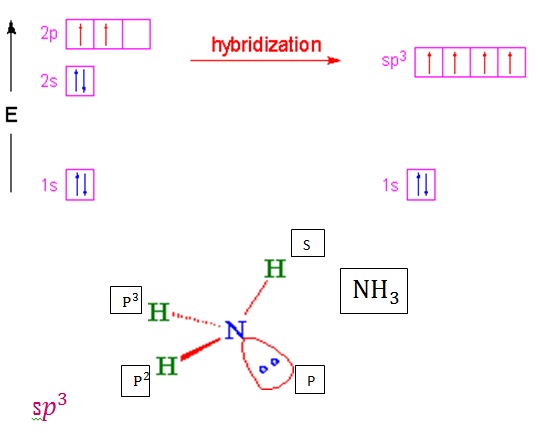
|
homogenous equilibrium
By: Mark Anthony Basilio ------The equilibrium between different chemical species present in the same or different phases is called chemical equilibrium. There are two types of chemical equilibrium. The equilibrium reactions in which all the reactants and the products are in the same phase are called homogeneous equilibrium reactions.
C2H5OH(l)
+ CH3COOH(l) N2(g) + 3H2(g) 2SO2(g) + O2(g) The equilibrium system, ethanol-acetic acid-ethyl acetate-water, is well known. The equation for this equilibrium is: C2H5OH + CH3COOH <-----> CH3COOC2H5 + H2O Equilibrium is established very slowly at room temperature when these four substances are mixed. The rate of reactions (both forward and reverse) can be accelerated by using a catalyst so that the equilibrium can be more rapidly established. 3 M HCl is used in this experiment as a catalyst, and the equilibrium at room temperature should be established in a few days. This means that in order to successfully complete this experiment, a series of combinations of reactants and/or products must be prepared a few days before the actual experiment. The equilibrium constant is then calculated by the equation: Using aA<----->bB Kc=[B]a/[A]b We derive this Kp=PbB/PaB to get Kp=Kc(RT)N Kc = [pure ethyl acetate] [water] / [ethanol] [glacial acetic acid] The four quantities in the above equation may be replaced by the number of moles of the four substances involved since the volume is constant in each mixture. Using aA<----->bB Kc=[B]a/[A]b We derive this formula Kp=PbB/PaB to get Kp=Kc(RT)N |

Gas Equilibrium Constants, Kc And KpRosiel MarianoKc and Kp are the equilibrium constants of gaseous mixtures. Kc=molar concentration
of products/molar concentration of reactants
with each concentration raised to the power of the corresponding stoichiometric coefficient. -If we express the
equilibrium constant in terms of partial pressures instead of molar
concentrations, the result is still a constant. The equilibrium constant in
terms of partial pressures is denoted as Kp. THIS ARE SOME WAYS TO WRITE THE GAS EQUILIBRIUM CONSTANT1. In equilibrium equations, even though the arrows point both ways (  ) we usually associate the right as reactants and the left as products. ) we usually associate the right as reactants and the left as products.2. The products are on the TOP of the fraction (the numerator). 3. The reactants are on the BOTTOM of the fraction (the denominator). 4. The concentrations of the products and reactants are always raised to the power of their coefficient in the balanced chemical equation. 5. If any of the reactants or products are solids or liquids, their concentrations are equal to one because they are pure substances.    SAMPLE PROBLEMS WITH ANSWERS A 1.) NH4SH (s) NH3 (g) + H2S (g)Kc =  but since NH4SH is a solid, we get:
Kc = As for Kp, it is the same as Kc, but instead of brackets [ ], Kp uses parentheses ( ): Kp = 
Kp =  Kp =  2.) H2 (g) + I2 (g) 2HI (g)Kc = REFERENCE Kp =  http://chemwiki.ucdavis.edu/Physical_Chemistry/Chemical_Equilibrium/The_Equilibrium_Constant/Calculating_An_Equilibrium_Concentration_From_An_Equilibrium_Constant/Writing_Equilibrium_Constant_Expressions_Involving_Gases/Gas_Equilibrium_Constants,_Kc_And_Kp#Problems |


lewis acid and bases
By: cristel diane dela cruz
The Lewis definitions of acids and bases are even more inclusive than the Bronsted definitions. The Lewis definitions are that an acid is an electron-pair acceptor and a base is an electron-pair donor.
The term Lewis acid refers to a definition of acid published by Gilbert N. Lewis in 1923, specifically: An acid substance is one which can employ an electron lone pair from another molecule in completing the stable group of one of its own atoms. The term Lewis acid refers to a definition of acid published by Gilbert N. Lewis in 1923, specifically: An acid substance is one which can employ an electron lone pair from another molecule in completing the stable group of one of its own atoms. The modern-day definition of Lewis acid, as given by IUPAC is a molecular entity (and the corresponding chemical species) that is an electron-pair acceptor and therefore able to react with a Lewis base to form a Lewis adduct, by sharing the electron pair furnished by the Lewis base.[2] This definition is both more general and more specific—the electron pair need not be a lone pair (it could be the pair of electrons in a π bond, for example), but the reaction should give an adduct (and not just be a displacement reaction). A Lewis base, then, is any species that donates a pair of electrons to a Lewis acid to form a Lewis adduct.
The Lewis acid-base theory can also be used to explain why nonmetal oxides such as CO2 dissolve in water to form acids, such as carbonic acid H2CO3. CO2(g) + H2O(l) In the course of this reaction, the water molecule acts as an electron-pair donor, or Lewis base. The electron-pair acceptor is the carbon atom in CO2. When the carbon atom picks up a pair of electrons from the water molecule, it no longer needs to form double bonds with both of the other oxygen atoms as shown in the figure below 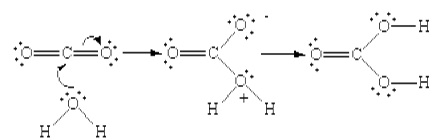 One of the oxygen atoms in the intermediate formed when water is added to CO2 carries a positive charge; another carries a negative charge. After an H+ ion has been transferred from one of these oxygen atoms to the other, all of the oxygen atoms in the compound are electrically neutral. The net result of the reaction between CO2 and water is therefore carbonic acid, H2CO3. |


bronsted-lowry acid-base theory
By: zhenna Marriz Aypa In this section we will consider the Brønsted-Lowry concept. This concept focuses on what an acid or base does.In chemistry, the Brønsted–Lowry theory is an acid-base theory, proposed independently by Johannes Nicolaus Brønsted and Thomas Martin Lowry in 1923. The Bronsted-Lowery concept of acids and bases is that acid-base reactions can be seen as proton-transfer reactions. This results in acids and bases being able to be defined in terms of this proton (H+) transfer. In this system,Brønsted acids and Brønsted bases are defined, by which an acid is a molecule or ion that is able to lose, or "donate," a hydrogen cation (proton, H+), and a base is a species with the ability to gain, or "accept," a hydrogen cation (proton). An Acid is a Proton Donor and a Base is a Proton Acceptor So what does this mean? For a reaction to be in equilibrium a transfer of electrons needs to occur. The acid will give an electron away and the base will receive the electron. Acids and Bases that work together in this fashion are called a conjugate pair made up of conjugate acids and conjugate bases. So what does this look like? (A stands for an Acidic compound and Z stands for a Basic compound) HA + Z ↔ A- + HZ+ A Donates H to form HZ+. Z Accepts H from A which forms HZ+ A- becomes conjugate base of HA and in the reverse reaction it accepts a H from HZ to recreate HA in order to remain in equilibrium HZ+ becomes
a conjugate acid of Z and in the reverse reaction it donates a H to
A- recreating Z in order to remain in equilibrium Properties of acids and bases It follows that, if a compound is to behave as an acid, donating a proton, there must be a base to accept the proton. So the Brønsted–Lowry concept can be defined by the reaction: acid + base conjugate base + conjugate acid. The conjugate base is
the ion or molecule remaining after the acid has lost a proton, and the conjugate acid is
the species created when the base accepts the proton. The reaction can proceed
in either forward or backward direction; in each case, the acid donates a
proton to the base. Example:
What happens in this reaction in aqueous solution is that a proton is transferred from H3O+ to NH3. This results in H3O+ losing a (H+), resulting in H2O. The NH3 gains the transferred proton, resulting in NH4+. We call H3O+ the proton donor, or acid. We call NH3 the proton acceptor, or base
The Bronsted-Lowery concept defines something as either an acid or base
depending on its function in the acid-base (proton transfer) reaction. Some
things can act as either an acid or a base. These are called amphiprotic species, they can either lose or gain a proton,
depending on the other reactant. An example of an amphiprotic species would be:
In the Bronsted-Lowery concept we
have found that: A base is a species that accepts protons, while an acid is a species that donates protons. Acids and bases can be ions as well as molecular substances. Some species can act as either acids or bases, depending on what the other reactant is. |
strengths Of acids and basesBy: kathleen caralde What Makes a Strong Acid or Strong Base? Strong electrolytes are completely dissociated into ions in water. The acid or base molecule does not exist in aqueous solution, only ions. Weak electrolytes are incompletely dissociated. Strong Acids Strong acids are strong electrolytes that, for practical purposes, are assumed to ionize completely in water. Strong acids completely dissociate in water, forming H+ and an anion. There are six strong acids. The others are considered to be weak acids. Most of them are inorganic acids. You should commit the strong acids to memory: · HCl - hydrochloric acid · HNO3 - nitric acid · H2SO4 - sulfuric acid NOTE: this is a diprotic; we show only the first stage of ionization here. · HBr - hydrobromic acid · HI - hydroiodic acid · HClO4 - perchloric acid Weak Acids A weak acid only partially dissociates in water to give H+ and the anion. Examples of weak acids include hydrofluoric acid, HF, and acetic acid, CH3COOH. Weak acids include: · Molecules that contain an ionizable proton. A molecule wih a formula starting with H usually is an acid. · Organic acids containing one or more carboxyl group, -COOH. The H is ionizable. · Anions with an ionizable proton. (e.g., HSO4- → H+ + SO42-) · Cations · transition metal cations · heavy metal cations with high charge · NH4+ dissociates into NH3 + H+ Strong Bases Strong bases are all strong electrolytes that ionizes completely in water. It dissociate 100% into the cation and OH- (hydroxide ion). The hydroxides of the Group I and Group II metals usually are considered to be strong bases. · LiOH - lithium hydroxide CsOH - cesium hydroxide · NaOH - sodium hydroxide *Sr(OH)2 - strontium hydroxide · KOH - potassium hydroxide Ba(OH)2 - barium hydroxide · RbOH - rubidium hydroxide *Ca(OH)2 - calcium hydroxide
* These bases completely dissociate in solutions of 0.01 M or less. The other bases make solutions of 1.0 M and are 100% dissociated at that concentration. There are other strong bases than those listed, but they are not often encountered. Weak Bases Weak bases, like weak acids, are weak electrolytes. Examples of weak bases include ammonia, NH3 (note: ammonia does not ionizelike an acid because it does not split up to form ions the way, say, HCL does), and diethylamine, (CH3CH2)2NH. · Most weak bases are anions of weak acids. · Weak bases do not furnish OH- ions by dissociation. Instead, they react with water to generate OH- ions.
TABLE1 lists some important conjugate acid-base pairs, in order of their relative strengths. Conjugate acid-base have the following properties:
1. If an
acid is strong, its conjugate acid-base has no measurable strength. Thus, the 2.
Acids weaker than
3. The
For this
reason the oxide ion does not exist in aqueous solutions. EXAMPLE: Calculate the pH of (a) a STRATEGY: Keep in mind that HCl is a strong acid and 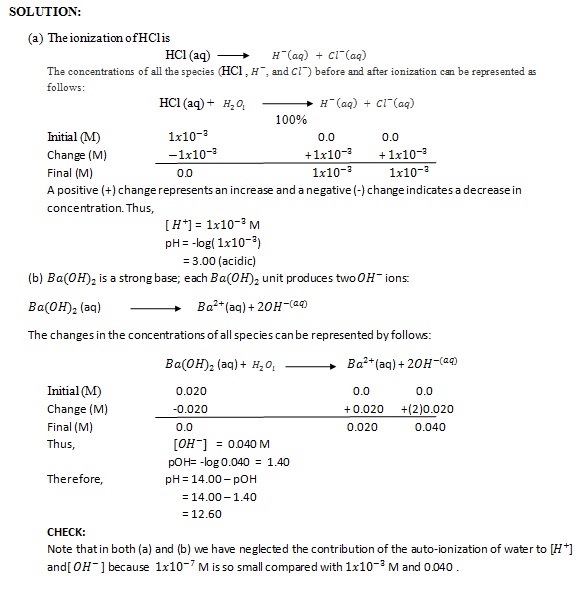 |