Alkanes By: Cristel Imbag ALKANES Alkanes are saturated hydrocarbons. They consist only of hydrogen and carbon atoms, all bonds are single bonds, and the carbon atoms are not joined in cyclic structures but instead form a simple chain. They have the general chemical formula CnH2n+2. The simplest possible alkane (the parent molecule) is methane, CH4. There is no limit to the number of carbon atoms that can be linked together, the only limitation being that the molecule is acyclic, is saturated, and is a hydrocarbon. Saturated oils and waxes are examples of larger alkanes where the number of carbons in the carbon backbone is greater than 10. Alkanes are not very reactive and have little biological activity. Alkanes can be viewed as a molecular tree upon which can be hung the more biologically active/reactive portions (functional groups) of the molecule. STRUCTURE: Saturated hydrocarbons can be: * linear (general formula CnH2n + 2) wherein the carbon atoms are joined in a snake-like structure *
branched (general formula CnH2n + 2, n > 3) wherein the carbon
backbone splits off in one or more directions * cyclic (general formula
CnH2n, n > 2) wherein the carbon backbone is linked so as to form a
loop. Step for naming alkane: * Count the number of carbons in the longest carbon chain. * Number each carbon giving all the substituents lowest number. * Name the substituents (if more than one of the same, use prefixes). * If more than one side chain, name in alphabetic order. * Use hyphens to separate numbers from words and comma to separate numbers. CYCLOALKANES Cycloalkanes (also called naphthenes - not to be
confused with naphthalene) are types ofalkanes that have one or more
rings of carbon atoms in the chemical structure of theirmolecules.
Alkanes are types of organic hydrocarbon compounds that have only
singlechemical bonds in their chemical structure. Cycloalkanes consist
of only carbon (C) andhydrogen (H) atoms and are saturated because there
are no multiple C-C bonds tohydrogenate (add more hydrogen to). A
general chemical formula for cycloalkanes would beCnH2(n+1-g) where n =
number of C atoms and g = number of rings in the molecule. IUPAC Rules for Nomenclature 1) Determine the cycloalkane to use as parent chain. The parent chain is one with the most amount of carbon atoms. If there are twocycloalkanes, use the cycloalkane with more carbons as the parent chain. 2) If there is an alkyl straight chain that is greater in the number of carbons than the cycloalkane, the alkyl chain must be used as the primary parent
chain. Cycloalkane acting as a substituent to an alkyl chain has an
ending "-yl" and therefore must be named as a cycloalkyl. 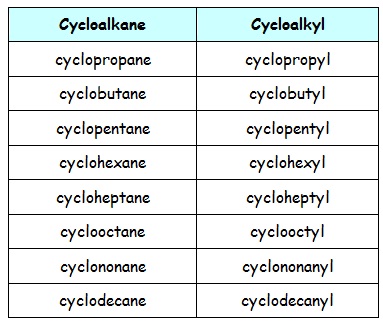 Reference: (Recommendations 1993). Blackwell Scientific. ISBN 0-632-03488-2. Retrieved 12 February 2007. 2. William Reusch. "Nomenclature - Alkanes". Virtual Textbook of Organic Chemistry. 3. William Reusch. "Examples of the IUPAC Rules in Practice". Virtual Textbook of Organic Chemistry. |
Alkynes By: Reagan Delos Reyes Alkynes are hydrocarbons that have a triple bond between two carbon atoms, with the general chemical formula CnH2n-2. Alkynes are traditionally known as acetylenes, although the name acetylene also refers specifically to C2H2, known formally as ethyne using IUPAC nomenclature. Like other hydrocarbons, alkynes are generally hydrophobic but tend to be more reactive. 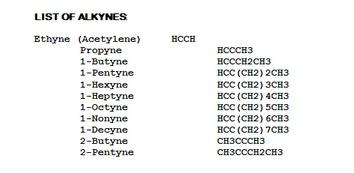 Structure and bonding In acetylene, the H–C≡C bond angles are 180°.
By virtue of this bond angle, alkynes tend to be rod-like.
Correspondingly, cyclic alkynes are rare. Benzyne is highly unstable.
The C≡C bond distance of 121 picometers is much shorter than the C=C
distance in alkenes (134 pm) or the C-C bond in alkanes (153 pm). 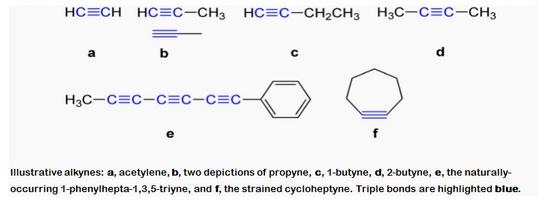 |
Alcohols By: Zhenna Marriz Aypa * Alcohols are the family of compounds that contain one or more hydroxyl (-OH) groups attached to a single bonded alkane * Alcohols are hydroxy-substituted alkanes, alkenes, or alkynes in which the substitution occurs on a saturated carbon. * Alcohols are represented by the general formula R-OH Physical properties
* Alcohols contain both a polar —OH group and a nonpolar alkyl group. • The general rule in solubility is “like dissolves like.” • Since the OH group makes alcohols polar, they will mix with polar solvents like water — as long as the carbon chain is fairly short. – The longer the carbon chain, the less soluble the alcohol is. Rules for naming the alcohol: 1. Find the longest chain containing the hydroxy group (OH). If there is a chain with more carbons than the one containing the OH group it will be named as a subsitutent. 2. Place the OH on the lowest possible number for the chain. With the exception of carbonyl groups such as ketones and aldehydes, the alcohol or hydroxy groups gets first priority for naming. 3. When naming a cyclic structure the -OH is assumed to be on the first carbon unless the carbonyl group is present, in which case the later will get priority at the first carbon. 4. When multiple -OH
groups are on the cyclic strucuture, number the carbons on which the
-OH. 5. Remove e from the parent alkane chain and add ol. When multiple
alcohols are present use di, tri, etc before the ol but after the parent
name. ex) 2,3-hexandiol. IF the carbonyl group is present the -OH group
is named as hydroxy, with the carbonyl group chaning the parent chain
name so that it ends with al or one. 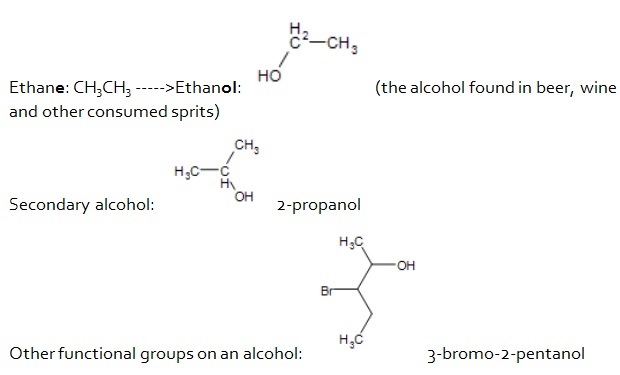 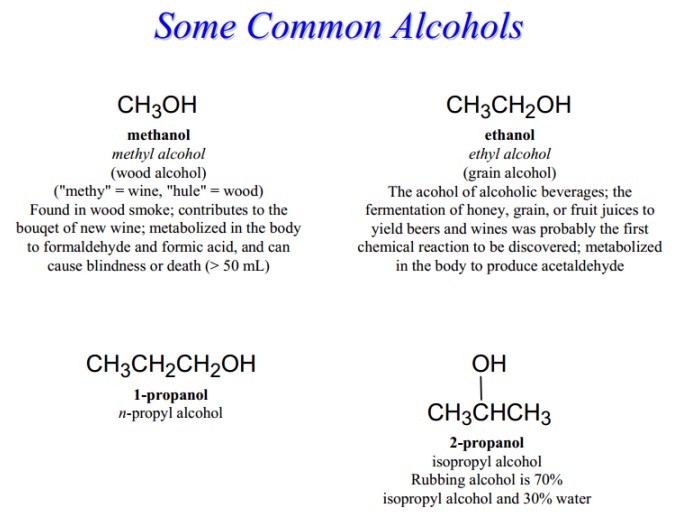 |
Aldehydes By: Cristel Diane Dela Cruz An Aldehyde is a compound containing a carboyl group with atleast one hydrogen attached to it. Smaller Aldehydes have a strong smell, in particular, formaldehyde Larger Aldehydes have a sweet or rosy smell, something like, benzaldehyde and cinnamaldehyde. NAMING ALDEHYDES The IUPAC system employs a series of rules to formulate compound names. The following rules explain how to name aliphatic aldehydes: 1. Pick out the longest continuous chain of carbon atoms that contains the carbonyl group. 2. The parent name comes from the alkane name of the same number of carbons. 3. Drop the -e ending of the alkane name and add -al. 4. Number the chain so that the carbonyl carbon has the lower possible number. 5. Locate and name substituents. |
Ketones By: Alleta Fae S. Liwag
Ketones Nomenclature:
Ketones take their name from their parent alkane chains. The -e is removed and replaced with -one. The alkane then becomes an alkanone. Numbering of the longest chain containing the ketone starts at the end closest to the carbonyl carbon. The smallest ketone propanone is commonly referred to as acetone. Aromatic ketones are aryl-substituted alkanones. If the ketone is present in the ring, then the compound is referred to as a cycloalkanone.
Examples: 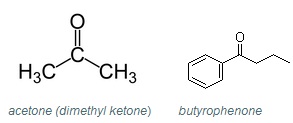 References: -http://chemwiki.ucdavis.edu/index.php?title=Wikitexts/UCD_Chem_118B/Chem_118B_Topics/Nomenclature_of_Aldehydes_%26_Ketones -http://www.brightstorm.com/science/chemistry/ |
 Ketones is one of the functional groups in organic chemistry. Functional groups are groups of atoms in hydrocarbons which are responsible for their chemical properties. Ketones is an organic compound with the structure RC(=O)-R', where R and R' can be a variety of
carbon-containing substituents. Ketones feature a carbonyl group (C=O) bonded to two other carbon atoms. Ketones are known and many
are of great importance in industry and in biology.
Ketones is one of the functional groups in organic chemistry. Functional groups are groups of atoms in hydrocarbons which are responsible for their chemical properties. Ketones is an organic compound with the structure RC(=O)-R', where R and R' can be a variety of
carbon-containing substituents. Ketones feature a carbonyl group (C=O) bonded to two other carbon atoms. Ketones are known and many
are of great importance in industry and in biology.Aldehydes By: Rosiel Mariano & Cristel Diane Dela Cruz
Aldehyde is an organic compound containing formyl group. Formyl group has a structure R-CHO, it consists of a carbonyl center bonded to hydrogen and an R group, which is a generic alkyl or side chain. The group without R is called the aldehyde group or formyl group. Aldehydes differ from ketones in that the carbonyl is placed at the end of a carbon skeleton rather than between two carbon atoms. Aldehydes are common in organic chemistry. It is often found in many fragrances.
NAMING ALDEHYDES · IUPAC: Replace -e with -al. · The aldehyde carbon is number 1. · If -CHO is attached to a ring, use the suffix -carbaldehyde.
3-methylpentanal
2-cyclopentenecarbaldehyde
Name as substituent
3-methyl-4-oxopentanal 3-formylbenzoic acid An Aldehyde is a compound containing a carboyl group with atleast one hydrogen attached to it.Smaller Aldehydes have a strong smell, in particular, formaldehyde Larger Aldehydes have a sweet or rosy smell, something like, benzaldehyde and cinnamaldehyde. NAMING ALDEHYDES The IUPAC system employs a series of rules to formulate compound names. The following rules explain how to name aliphatic aldehydes: 1. Pick out the longest continuous chain of carbon atoms that contains the carbonyl group. 2. The parent name comes from the alkane name of the same number of carbons. 3. Drop the -e ending of the alkane name and add -al. 4. Number the chain so that the carbonyl carbon has the lower possible number. 5. Locate and name substituents.
REFERENCES http://en.wikipedia.org/wiki/Aldehyde http://www.austincc.edu/cuzomba/Wade18powerpoint.ppt |


Ethers By: Kathleen Caralde Ethers are a class of organic compounds that contain an ether group —
an oxygen atom connected to two alkyl or aryl groups — of general
formula R–O–R'. Ethers are alkoxy (RO—)-substituted alkanes, alkenes,
and alkynes. As with alcohols, only saturated carbon atoms may be
substituted in alkenes and alkynes. 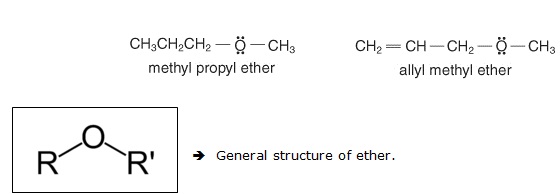 Ethers feature C-O-C linkage defined by a bond angle of about 104.5° and C-O distances of about 140 pm. The barrier to rotation about the C-O bonds is low. The bonding of oxygen in ethers, alcohols, and water is similar. In the language of valence bond theory, the hybridization at oxygen is sp3. Oxygen is more electronegative than carbon, thus the hydrogens alpha to ethers are more acidic than in simple hydrocarbons. They are far less acidic than hydrogens alpha to carbonyl groups (such as in ketones or aldehydes), however. Depending on the groups at R and R', ether is classified into two types: 1) Simple ethers or symmetrical ethers 2) Mixed ethers or asymmetrical ethers Nomenclature Ethers are commonly named by listing the names of the groups attached to the oxygen atom and adding the word ether. Examples include: 
References:
http://en.wikipedia.org/wiki/Ether#Structure_and_bonding https://www.khanacademy.org/science/organic-chemistry/alcohols-ethers-epoxides-sulfides/nomenclature-properties-ethers/v/ether-naming-and-introduction |
Esters By: Mark Anthony Basilio
Esters are chemical compounds consisting of a carbonyl adjacent to an ether linkage. They are derived by reacting an oxoacid with a hydroxyl compound such as analcohol or phenol.[1] Esters are usually derived from an inorganic acid or organic acid in which at least one -OH (hydroxyl) group is replaced by an -O-alkyl (alkoxy) group, and most commonly from carboxylic acids and alcohols. That is, esters are formed by condensing an acid with an alcohol.
IUPAC nomenclature of Esters Ester names are derived from the parent alcohol and the parent acid, where the latter may be an organic or an inorganic acid. Esters derived from the simplest carboxylic acids are commonly named according to the more traditional, so-called "trivial names" e.g. as formate, acetate, propionate, and butyrate, as opposed to the IUPAC nomenclature methanoate, ethanoate, propanoate and butanoate. Esters derived from more complex carboxylic acids are, on the other hand, more frequently named using the systematic IUPAC name, based on the name for the acid followed by the suffix -oate. For example the ester hexyl octanoate, also known under the trivial name hexyl caprylate, has the formula CH3(CH2)6CO2(CH2)5CH3. 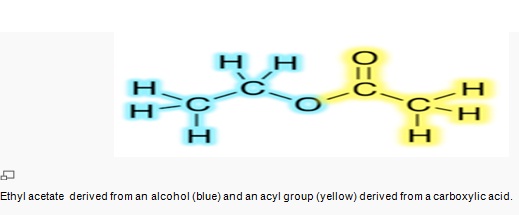 The standard system for naming esters uses the suffix -oate to indicate that
a molecule is an ester. |
