The Mole Concept
by: Zhenna Marriz
Aypa
In chemistry the mole
is a fundamental unit in the Système International d'Unités, the SI system, and
it is used to measure the amount of substance. This quantity is sometimes
referred to as the chemical entity, which can be an atom, molecule, formula unit, electron or proton. In Latin mole means a "massive heap" of material. It
is convenient to think of a chemical mole as such.
1 mole
C à 6.02 x 10²³
atoms 1 mole NaCl à 6.02 x 10²³ molecules
Atoms and molecules are incredibly small and even a tiny chemical sample contains an unimaginable number of them. Therefore, counting the number of atoms or molecules in a sample is impossible. The multiple interpretations of the mole allow us to bridge the gap between the submicroscopic world of atoms and molecules and the macroscopic world that we can observe To determine the chemical amount of a sample, we use the substance's molar mass, the mass per mole of particles. General Plan for Converting Mass, Amount, and Numbers of ParticlesSample Problem 1:
How many moles of Magnesium are 3.01 x 10²² atoms of magnesium? Solution: Analyze: Given: 3.01 x 10²² atoms of Mg Mole of Mg= ( ?) Compute: 3.01 x 10²² atoms of Mg x 1 mol of Mg 6.02 x 10²³ atoms of Mg = 0. 500 Mol Mg Sample Problem No. 2 How many moles are there in 29.0 grams of Sodium Chloride? Analyze: 29.0 g NaCl à mole(?) (MM): MM = 22.99 + 35.45 = 58.44 g NaCl Compute: 29.0 g Nacl x 1 mol NaCl 58.44 g NaCl = 0.496 mol NaCl Sample Problem No. 3 How many grams are in 7.20 mol of Dinitrogen Trioxide? Given: 7.20 mol N2O3 à g(?) (MM): N2(14.01 x 2) + O3(16x 3) = 76.02 mol of N2O3 Compute: 7.20 mol of N2O3 x 1 mol 76.02 mol of N2O3 = 0.0947 mol N2O3 |
Stoichiometryby: Jarlyn Liwag→ " Stoichiometry " was derived from: "Stoicheion" meaning element and "Metron" meaning measure. · deals with the relative quantities of Reactants and Products in chemical reactions. In a balanced chemical reaction, the relations among quantities of reactants and products typically form a ratio of whole numbers.
· used to find the right amount of reactants to use in a chemical reaction. Example : *Consider the complete combustion of natural gas Methane ( CH4 ) reacts with Oxygen gas ( O2 ) to produce CO2 and water ( H2O ). CH4 + 2O2 → CO2 + 2H2O *Hydrogen gas (H2)
reacts with Nitrogen gas (N2) to give ammonia (NH3) 3H2+ N 2 →2NH3
· often used to balance chemical equations .
*For example, the two diatomic
gases, hydrogen and oxygen, can combine to form
a liquid, water (H2O). 2H2 + O2 → 2H2O - describes the 2:1:2 ratio of hydrogen, oxygen, and water molecules in the above equation.
· is simply the study of the relationships or ratios between two or more substances undergoing a physical or chemical change (chemical reaction). → In Stoichiometry, we have different PROBLEMS.
· Mole-Mole Problems. · Mass-Mole Problems. · Volume-Volume Problems. |
Limiting and Excess Reagent
By: Alleta Fae S. Liwag · Limiting Reactant - The reactant in a chemical reaction that limits the amount of product that can be formed. The reaction will stop when all of the limiting reactant is consumed. · The limiting reagent is the reactant that is completely used up during the chemical reaction. · Excess Reactant - The reactant in a chemical reaction that remains when a reaction stops when the limiting reactant is completely consumed. The excess reactant remains because there is nothing with which it can react.
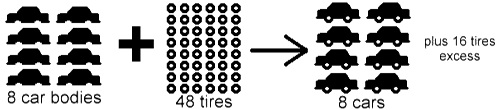
No matter how many tires there are, if there are only 8 car bodies, then only 8 cars can be made. Likewise with chemistry, if there is only a certain amount of one reactant available for a reaction, the reaction must stop when that reactant is consumed whether or not the other reactant has been used up. Example Limiting Reactant Calculation: A 2.00 g sample of ammonia is mixed with 4.00 g of oxygen. Which is the limiting reactant and how much excess reactant remains after the reaction has stopped? First, we need to create a balanced equation for the reaction:
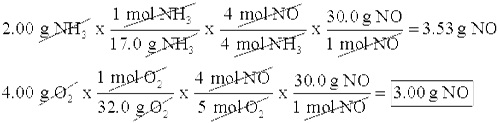
Next we can use stoichiometry to calculate how much product is produced by each reactant. NOTE: It does not matter which product is chosen, but the same product must be used for both reactants so that the amounts can be compared.
The reactant that produces the lesser amount of product in this case is the oxygen, which is thus the "limiting reactant." Next, to find the amount of excess reactant, we must calculate how much of the non-limiting reactant (ammonia) actually did react with the limiting reactant (oxygen).
We're not finished yet though. 1.70 g is the amount of ammonia that reacted, not what is left over. To find the amount of excess reactant remaining, subtract the amount that reacted from the amount in the original sample.
|


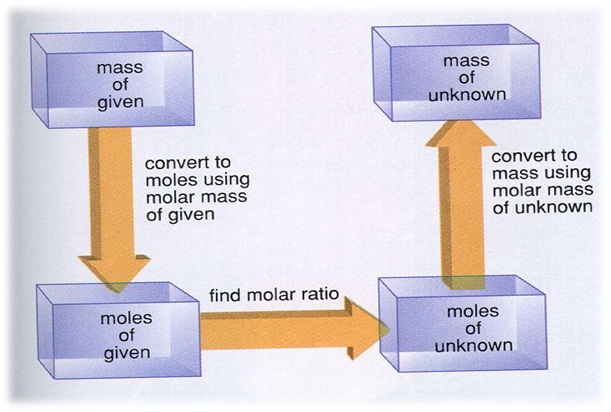
Mass - Mass Stoichiometry by: Cristel Diane Dela Cruz A mass to mass problem is one in which the mass of a reactant or product is given. You are then asked to calculate the mass of another reactant required or the mass of another product formed. There are four steps involved in solving these problems: 1. Make sure you are working with a properly balanced equation. 2. Convert grams of the substance given in the problem to moles. 3.
Construct
two ratios - one from the problem and one from the equation and set them equal.
Solve for "x," which is usually found in the ratio from the problem. 4. Convert moles of the substance just solved for into grams.
Example : Follow the steps in the diagram Under severe conditions; high temperature, pressure and concentration; hydrogen gas and nitrogen gas can be coerced into forming ammonia, NH3, Also a gas at these temperatures. What mass of N2 would be required if mixed with excess hydrogen gas (meaning more than enough - the reaction will cease when the nitrogen runs out) to produce 850g ammonia? What mass of H2 would be used? 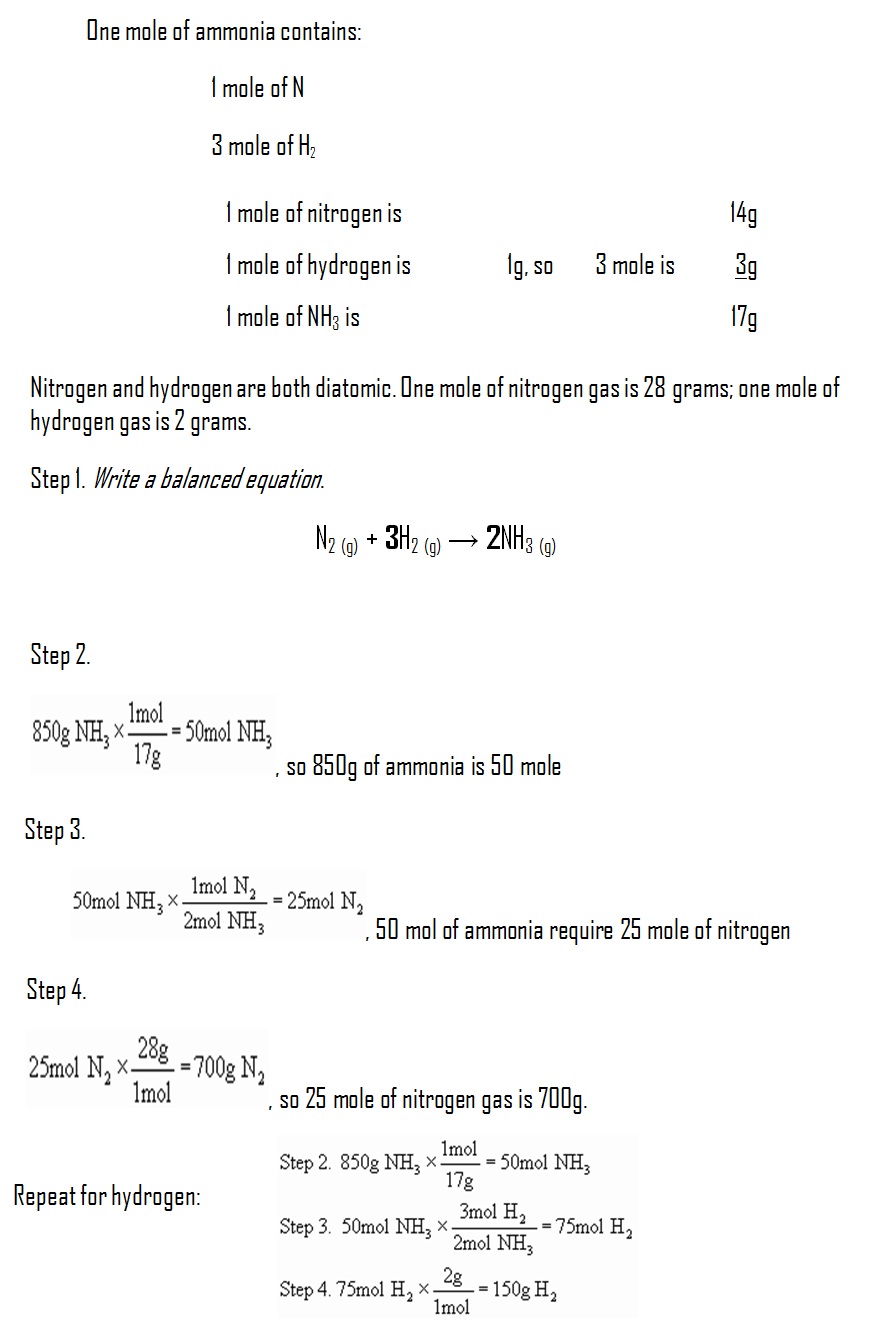 |
Mass - Volume Stoichiometry
By: Rosiel Mariano There are four steps involved in solving mass-volume problems:
FORMULA:
At STP, 1 mol of gas = 22.4 liters
Sample problems: 1.) An excess of hydrogen reacts with 14.0 g of nitrogen. How many liters of ammonia are produced at STP? 3 H2 + N2 → 2 NH3
2.) What volume of hydrogen at STP can be produced when 6.54 g of Zn reacts with hydrochloric acid, HCl? Zn + 2 HCl → H2 + ZnCl2
|
Gas Stoichiometry by: Cristel Imbag Stoichiometry is a branch of chemistry that deals with the relative quantities of reactants and products in chemical reactions. In a balanced chemical reaction, the relations among quantities of reactants and products typically form a ratio of whole numbers. For example, in a reaction that forms ammonia (NH3), exactly one molecule of nitrogen (N2) reacts with three molecules of hydrogen (H2) to produce two molecules of NH3: N2 + 3H2 → 2NH3
Gas stoichiometry deals with reactions involving gases, where the gases are at a known temperature, pressure, and volume, and can be assumed to be ideal gases. For gases, the volume ratio is ideally the same by the ideal gas law, but the mass ratio of a single reaction has to be calculated from the molecular masses of the reactants and products. In practice, due to the existence of isotopes, molar masses are used instead when calculating the mass ratio. Gas stoichiometry is the quantitative relationship (ratio) between reactants and products in a chemical reaction with reactions that produce gases. Gas stoichiometry applies when the gases produced are assumed to be ideal, and the temperature, pressure, and volume of the gases are all known. The ideal gas law is used for these calculations. Often, but not always, the standard temperature and pressure (STP) are taken as 0 °C and 1 bar and used as the conditions for gas stoichiometric calculations. Gas stoichiometry calculations solve for the unknown volume or mass of a gaseous product or reactant. For example, if we wanted to calculate the volume of gaseous NO2 produced from the combustion of 100 g of NH3, by the reaction: 4NH3 (g) + 7O2 (g) → 4NO2 (g) + 6H2O (l) we would carry out the following calculations:
There is a 1:1 molar ratio of NH3 to NO2 in the above balanced combustion reaction, so 5.871 mol of NO2 will be formed. We will employ the ideal gas law to solve for the volume at 0 °C (273.15 K) and 1 atmosphere using the gas law constant of R = 0.08206 L · atm · K−1 · mol−1
Gas stoichiometry often involves having to know the molar mass of a gas, given the density of that gas. The ideal gas law can be re-arranged to obtain a relation between the density and the molar mass of an ideal gas:
and thus:
Sample Problems: 1) A quantity of gas at a temperature of 18oC has a volume of 124.5 cm3 at a pressure of 97.8 KPa. How many moles of gas are there? PV=nRT n= [
mol K ][97.8
KPa ][0.1245dm3]
= 0.005 mol gas 2) At
a pressure of 105.2 KPa, 1.42 moles of a gas occupy 1.74 dm3.
What is the T = [
mol K ][105.2 KPa][1.74dm3] =
15.51K 3) A
gas at 1.24oC occupies a 3.51 dm3 container. If
there are 3.34 moles of the gas, P= [3.34 mol][8.31 dm3 KPA][1.24oC
+ 273=K] = 2170 KPa 4) If
1.39 g of carbon monoxide is reacted with oxygen, what volume of carbon dioxide 2CO + O2 --> 2CO2 mol CO2
= [1.39g CO][1mol CO][2 mol CO2 ] = 0.05 mol CO2 V= [0.05
mol][8.31 dm3 KPA][12.3oC + 273=K] = 1.09 dm3 5) If
14.4 dm3 of ethane is combusted at 102.7oC and 99.3KPa,
how many grams of 2C2H6 + 7O2 --> 4CO2 + 6H2O
n= [ mol
K ][99.3
KPa
][14.4 dm3] = 0.46 mol C2H6
mass H2O = [0.46 mol C2H6][6 mol H2O
][18 g H2O] = 24.8 g H2O
REFERENCES: Ø http://goldbook.iupac.org/S06025-plain.html Ø IUPAC. Compendium of Chemical Terminology, 2nd ed. (the "Gold Book"). Compiled by A. D. McNaught and A. Wilkinson. Blackwell Scientific Publications, Oxford (1997). XML on-line corrected version: http://goldbook.iupac.org (2006-) created by M. Nic, J. Jirat, B. Kosata; updates compiled by A. Jenkins. ISBN 0-9678550-9-8. doi:10.1351/goldbook. Entry: "stoichiometric number". Ø IUPAC Compendium of Chemical chemistry/chprbgsst.htm Terminology 2nd Edition (1997) Ø http://www.sciencebugz.com/ |


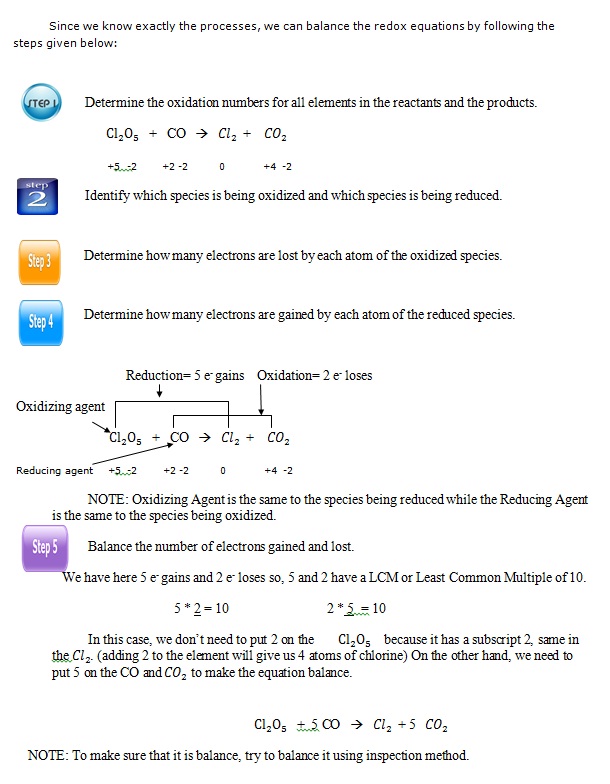
Balancing Redox Equations
by: Kathleen Caralde
Redox (reduction-oxidation) reactions
include all chemical reactions in which atoms have their oxidation
state changed. A reaction in which oxidation and reduction take place
simultaneously is called a redox
reaction. Oxidation number Method OBJECTIVES: In this article you will learn to write a balanced equation for a redox reaction using Oxidation number Method. Identify the oxidation numbers of the elements in the equation. State the characteristics of a redox reaction and identify the oxidizing agent and reducing agent. Before we will get to explanation, very important disclaimer: oxidation numbers don't exist. They were invented to help in charge accounting needed when balancing redox reaction equations, but they don't refer to any real life chemical concept. The general idea behind the oxidation numbers (ON) method for balancing chemical equations is that electrons are transferred between charged atoms. These charges (the positive or negative number that indicates how many electrons an atom has gained, lost, or shared to become stable) - assigned to individual atoms - are called oxidation numbers, just to remind you that they don't reflect real structure of the reagents. How do we use oxidation numbers for balancing? First of all, we have to understand that oxidation means increase of oxidation number, while reduction means decrease of oxidation number. In both cases change of oxidation number is due to electrons lost (oxidation) or gained (reduction). We calculate oxidation numbers for all atoms present in the reaction equation (note that it is not that hard as it sounds, as for most atoms oxidation numbers will not change) and we look for a ratio that makes the number of electrons lost equal to the number of electrons gained. That gives us additional information needed for reaction balancing.
CHEMISTRY IMPORTANT TERMS REDOX REACTION - oxidation and reduction reactions that occurs simultaneously. -Process to characterize by increa - Losing or gaining of electrons
- It is characterize by an increase of oxidation number REDUCTION - Process by which a substance gains e- - Decrease of oxidation number REDUCING AGENT- substance that causes another substance to be reduced. OXIDIZING AGENT- substance that causes another substance to be oxidized. Reference: http://wiki.answers.com/Q/What_is_an_oxidation_number#ixzz216Q2GDYK http://science.widener.edu/~svanbram/chem146/ch20/redox.html http://www.docslide.com/oxidation-reduction-redox-reactions-2/ http://www.scribd.com/doc/39095944/Chapter-7-Oxidation-and-Reduction-Reactions |